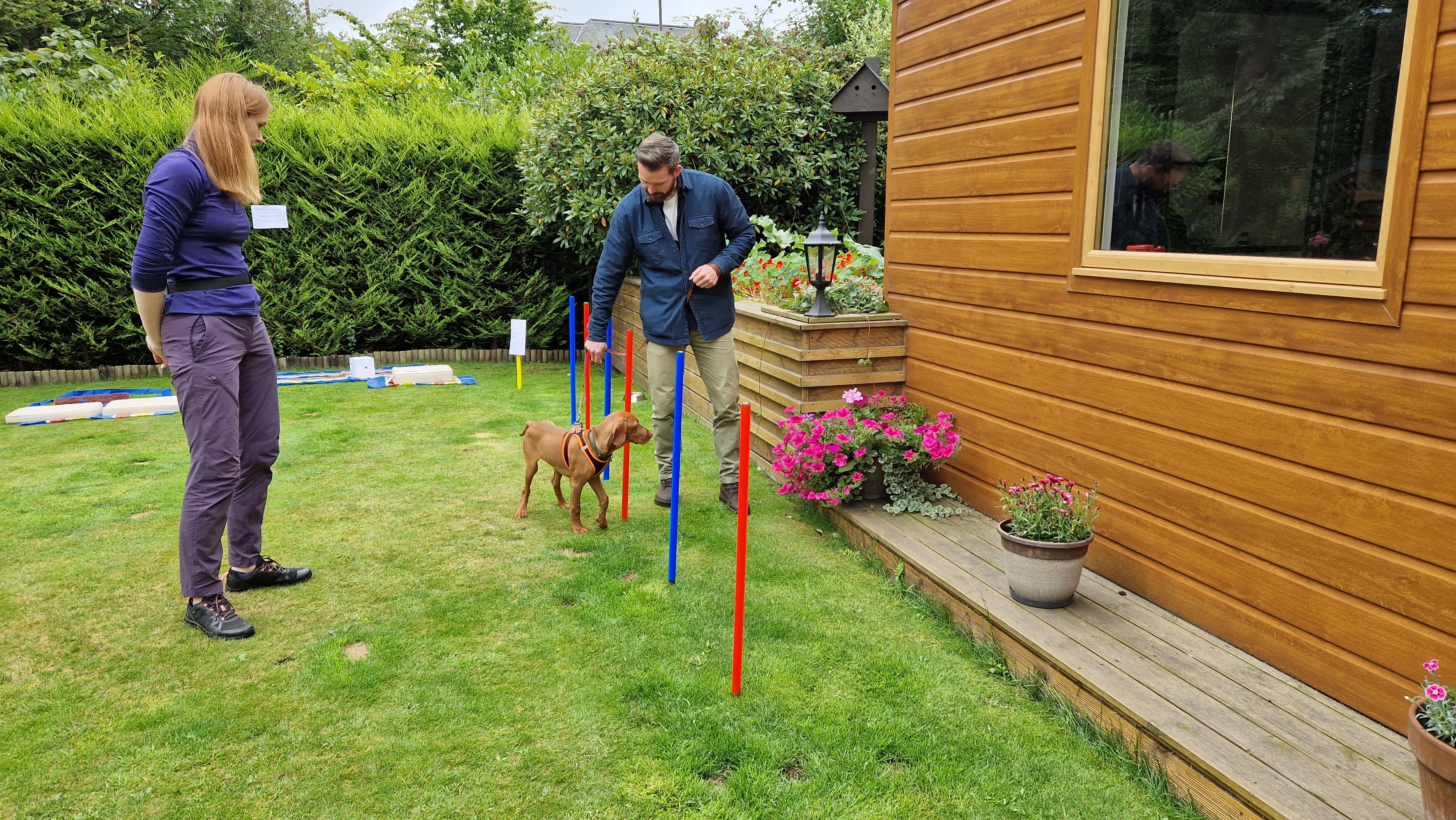
You’ve probably seen the phrase “force-free” stamped on a dozen trainer websites, mine included. But what does it actually mean? And — more importantly — does it work?
This post is the long answer. (The short answer is: yes, and the science is overwhelming.)
What “force-free” rules out
Force-free training is defined as much by what it doesn’t use as by what it does. A force-free trainer will never:
- Use tools designed to cause pain or fear: prong collars, choke chains, e-collars (shock collars), spray bottles, pet correctors.
- “Alpha roll” or pin a dog to the ground.
- Use leash pops, jerks, or physical corrections.
- Intimidate, startle, or threaten a dog into compliance.
That list isn’t moral posturing. It’s based on decades of peer-reviewed evidence showing that aversive methods do suppress behaviour in the short term — and also significantly increase the risk of fear, anxiety, and aggression in the long term. The American Veterinary Society of Animal Behavior, the European Society of Veterinary Clinical Ethology, and the British Veterinary Association have all issued position statements saying the same thing: don’t use this stuff, even if it looks like it works.
What force-free training uses instead
Force-free training is built on two pillars from the science of how animals learn:
- Positive reinforcement — when your dog does something you like, you make something good happen. Food, play, freedom, praise. The behaviour gets stronger.
- Antecedent arrangement — you set up the environment so the dog is more likely to make good choices in the first place. Block the view of the postie. Move the bin. Walk at a quieter time.
That’s it. Two pillars. The whole thing fits on a postcard.
”But my dog is stubborn”
Here’s the thing — and I say this gently — dogs are not stubborn. Dogs do what works. If your dog is “ignoring” a cue, one of three things is true:
- The behaviour hasn’t been taught well enough yet.
- The environment is too distracting for the current level of training.
- The reward isn’t worth it to that dog in that moment.
All three are fixable. None of them require force.
Does it actually work?
Yes, and the research is now very clear. Studies comparing reward-based and aversive methods consistently find that reward-based dogs learn faster, retain better, show less stress, and have stronger relationships with their handlers. There is no behaviour problem for which aversive methods produce better long-term results than force-free ones. Not pulling on the lead. Not reactivity. Not aggression. Not recall.
The dogs I work with — anxious dogs, reactive dogs, “stubborn” dogs, dogs who failed traditional classes — almost always make their biggest leaps when their humans finally let go of the idea that they need to make the dog do anything, and start setting them up to want to.
If you’d like to see what that looks like in practice, book a free consultation. I’d love to meet you both.